
AI SEO writer: the full workflow from query research to published draft
A generic AI writer answers your prompt. An AI SEO writer has to research the query, commit to a structure, keep the facts traceable and stay editable afterwards. This page walks the whole wordiqo workflow — research pass, draft, on-page checks, editing, export — and shows exactly where it differs from prompting a chatbot.
The workflow, step by step
Every run follows the same five stages. You can stop after any of them: the research and metadata are useful even if you rewrite the body yourself.
- Research the query — wordiqo pulls real query variations from Google Autocomplete and analyses the pages currently ranking, so the outline reflects what searchers actually ask instead of what a model assumes.
- Build the outline — The primary keyword and its secondary cluster are mapped to specific H2 and H3 sections before any prose exists, which is what stops the draft drifting into a generic blog template.
- Draft with constraints — One H1, answer-first sections, and an introduction that is explicitly forbidden from echoing the title — the first sentence has to open on a date, number, event or direct answer.
- Check on-page signals — Meta title and description, keyword density per term, heading tree and the source list are all shown next to the draft, not buried in a separate audit tool.
- Edit, expand, export — Rewrite any section on its own, queue extra topics with a placement preview, then copy as semantic HTML or export to DOCX.
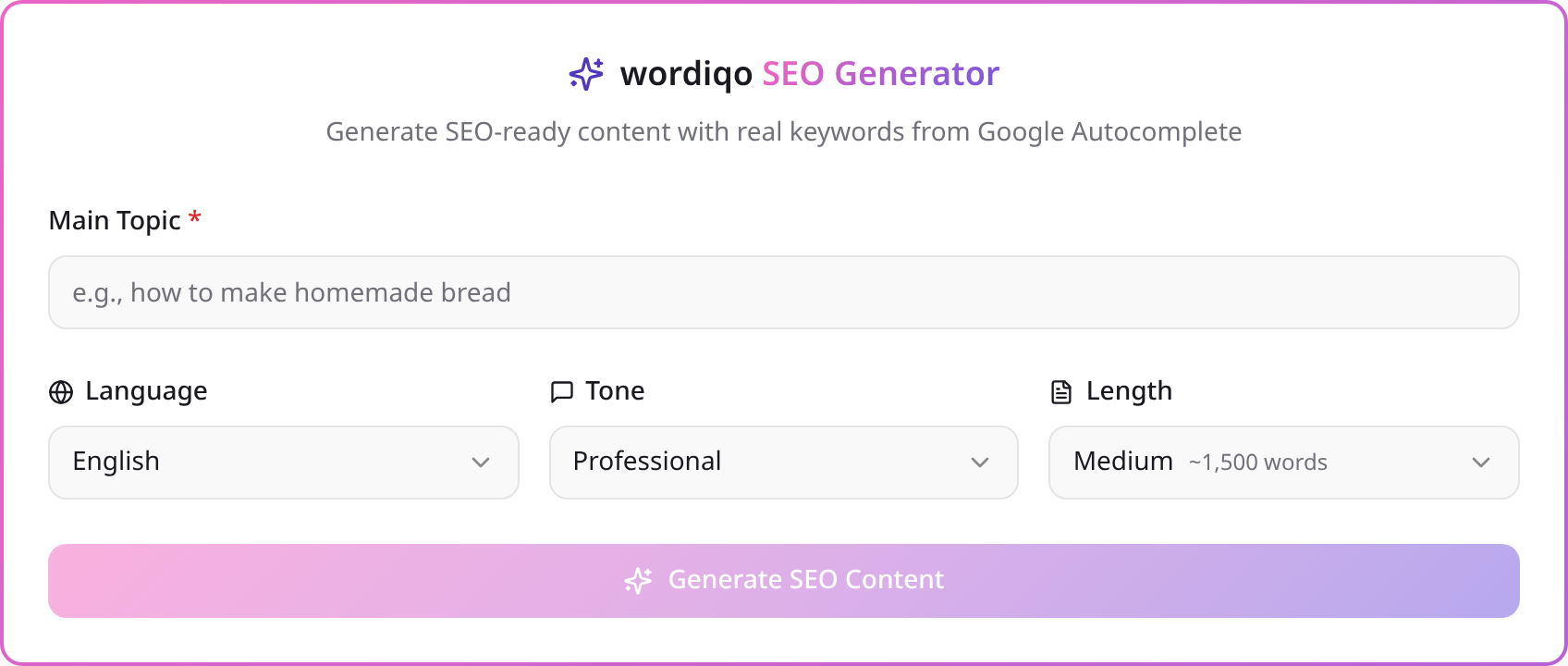
How this differs from a general-purpose AI writer
The gap is not writing quality — modern models all write fluent sentences. The gap is everything around the sentences.
| Step | Generic AI chat | wordiqo |
|---|---|---|
| Query research | Whatever the model recalls | Google Autocomplete variations plus an analysis of ranking pages |
| Sources | Often fabricated or absent | Only URLs returned by the research step; nothing invented |
| Structure | Prompt-dependent, frequently multiple H1s | One H1, enforced H2/H3 hierarchy |
| Metadata | Ask separately, then trim by hand | Meta title and description written to length in the same run |
| Keyword control | No visibility | Density read-out per primary and secondary term |
| Revision | Regenerate the whole answer | Inline editing and single-section rewrites |
| Handover | Copy-paste plain text | Copy as semantic HTML or export DOCX |
What "researched" means here
Research is a separate pass with its own output, not a phrase in a prompt. You can inspect it before trusting the draft.
- Autocomplete and related-question angles used to shape the outline, not to pad a keyword list
- A read of the pages currently ranking, so the draft can take a distinct position instead of restating consensus
- A citable source list containing only URLs the search step actually returned
- A primary keyword plus a secondary cluster, each attached to the section that should cover it
Quality guards applied before you see the draft
Generation is validated against a fixed set of checks. Failing content is flagged or regenerated rather than silently shipped.
Fact density
Paragraphs built from qualifiers with no concrete data are flagged so you can replace them instead of publishing filler.
Pattern detection
Stock AI phrasing, empty transitions and repeated sentence shapes are rewritten, which matters when half the SERP is generated by the same three models.
Intent and entity coverage
The draft has to answer the query type it targets and mention the entities a reader expects. A commercial query answered with a definition is a failed draft.
Who this workflow suits
It is built for one strong piece at a time, with a human in the loop.
- Solo founders and marketers who publish weekly and cannot run a four-tool research stack
- SEO consultants who want the research and metadata layer done before they write the opinionated parts
- Teams publishing in Spanish, French, German, Portuguese or Italian — content is written natively in the chosen language, not translated afterwards
Questions people ask
Can I try the AI SEO writer without an account?
- Yes. You can generate as a guest; saving, copying and exporting require an account, and anything you generated as a guest syncs to it when you sign in.
Does it invent sources or statistics?
- No. Citations are restricted to URLs the research step actually returned, and unverifiable claims are the specific thing the fact-density and pattern checks look for.
Can I keep editing after generation?
- Editing is the main working mode. Headings and paragraphs are editable in place with autosave, any single section can be rewritten alone, and new topics can be inserted with a placement preview before anything changes.
What if I already have the text?
- Skip generation and run the SEO text optimizer instead: it audits headings, density and metadata, then rewrites and enriches your existing copy.
Keep reading
- see everything the AI SEO content generator returns — the deliverables from one run: metadata, outline, keyword map, sources, alt text and exports.
- long-form article writing and editing — section rewrites, the add-content queue and placement previews for blog-length pieces.
- the on-page rules behind every draft — single H1, heading hierarchy, title length and keyword density, explained as a checklist.
- audit an existing page with the SEO text optimizer — already have a draft? Enrich it instead of regenerating from zero.