
SEO content generator, or an SEO check on the content you already have
Most people searching for a SEO content generator do not need a new article — they need an existing page to pass the on-page basics. This page gives you the checklist those tools are supposed to enforce, and a free optimizer that runs it on text you paste.
The on-page checklist, in the order it matters
Run this against any page, generated or hand-written. Each item is either satisfied or it is not — no scores, no arbitrary grade out of 100.
| Check | Pass condition | Common failure |
|---|---|---|
| Single H1 | Exactly one H1, matching the page intent | A hero heading plus a second H1 further down |
| Heading tree | H3s only under an H2, no skipped levels | H4 used for visual size |
| Meta title | Fits without truncation, primary term near the front | Brand name first, keyword cut off |
| Meta description | A reason to click, not a summary | The first paragraph, pasted |
| Keyword usage | Natural density, visible per term | Exact-match repetition in every heading |
| Answer placement | Direct answer near the top of the section | Three paragraphs of preamble |
| Duplication | No repeated headings or near-identical paragraphs | Merged content restating existing text |
Run the checklist instead of reading it
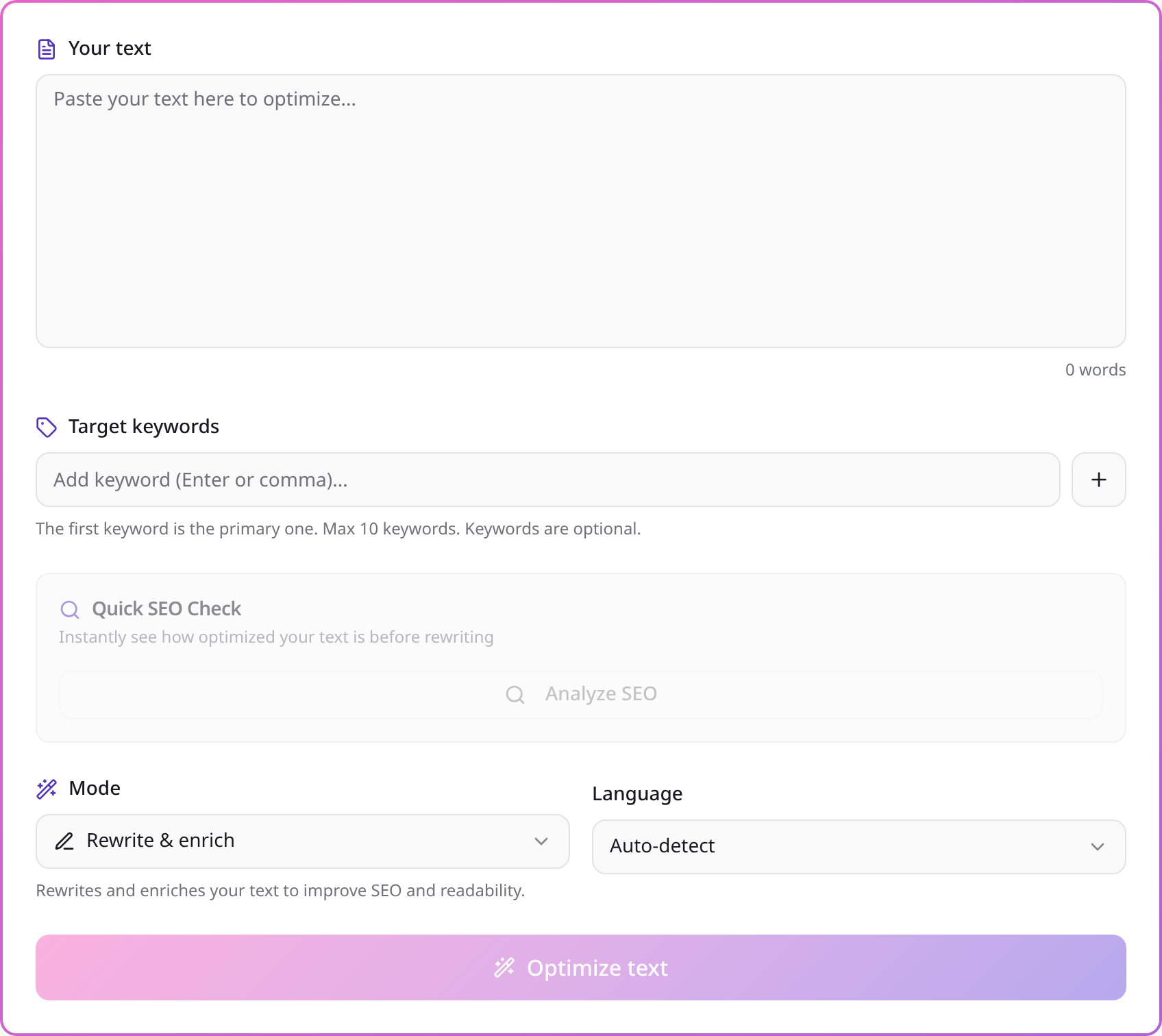
The optimizer takes pasted text and up to ten target keywords, with the first treated as primary. The Quick SEO Check reports where the text stands before anything is rewritten, so you can see whether a rewrite is even needed.
If it is, the rewrite keeps your facts and fixes the structure: headings, emphasis, meta title and meta description, and passages reshaped so an answer comes first.
Generate only when there is nothing to fix
Generation and optimisation solve different problems, and picking the wrong one wastes a day.
| Situation | Use |
|---|---|
| The page exists but underperforms | The optimizer — audit, then rewrite and enrich |
| The page exists and is thin | The optimizer, then the add-content queue to fill real gaps |
| No page yet, topic decided | The generator — research pass, outline, draft, metadata |
| A long piece needing repeated revision | The article editor with per-section rewrites |
Answer-first structure, for search results and assistants
Results increasingly quote a passage rather than rank a page. Sections that state the answer in the first sentence and then justify it read better for people and give engines and assistants a clean block to lift. Lists and tables are used where the content is genuinely enumerable — not sprinkled in because lists rank.
What this tool will not do
It will not stuff keywords, spin near-duplicate pages for every query variant, or invent statistics and citations. Those tactics get pages filtered, and the guard rails exist specifically to prevent them.
Questions people ask
Is the SEO check free?
- You can paste text and run the check and rewrite without an account. Saving, copying and exporting the result require signing in.
How many keywords should I target on one page?
- One primary term and a small supporting cluster. The optimizer accepts up to ten and treats the first as primary, which is already more than most single pages should carry.
What is a good keyword density?
- There is no target number to hit. Density is reported per term so over-optimisation becomes visible; if a phrase appears in every heading, that is the signal to vary it.
Keep reading
- the on-page SEO checklist that is actually checkable — all 21 items with a pass condition each, including the ones worth ignoring.
- how to run a content audit on a published page — the five decisions an audit can end in, and the data behind each one.
- one H1 per page: what actually breaks with two — the most common structural finding, and what it really costs.
- open the free SEO text optimizer — paste a page and get the heading map, density read-out and metadata fixes.
- what the AI SEO content generator returns — the full deliverable list when you are starting from a topic instead of a draft.
- the research pass behind generated drafts — why the outline is built from real query data before writing starts.
- applying these rules at scale — how the same checklist keeps templated pages out of thin-content territory.